


Blog · Quoting and margin
38% of orders need a manual price fix. Here are 6 places your quotes leak margin.
Short answer: Most margin doesn’t leak in the negotiation. It leaks in the handoffs around the quote: old costs, the wrong price level, unguarded discounts, missing freight, slow turnaround and no follow-up. The fix is a quoting system built on your own price book, with standing rules from your best estimator and a person signing off on every number.
Here’s the picture I use with owners. A quote is a bucket you carry from the warehouse to the customer. Nobody kicks it over. It drips the whole way there.
The drips are bigger than they look. In a 2026 survey by Distribution Strategy Group and Cavallo, 37.8% of distributor orders needed manual pricing intervention. Half of distributors passed through less than 90% of supplier price increases. And on average, 10.5% of invoices lost money at the transaction level (DSG and Cavallo).
Costs keep moving, too. In the MDM and Baird 1Q26 survey, sub-$100M distributors named vendor cost increases as their top margin drain (MDM).
Definition: Margin leakage. Margin leakage is the gap between the margin a quote should earn and the margin that actually gets billed. It usually hides in small handoffs, not in one big mistake.
So where does it drip?
Where do distributors lose margin in quotes?
In six places.
The cost changed and the price didn’t
A vendor email with new costs sits in an inbox. Meanwhile your reps quote on last month’s numbers. Every day that update waits, you sell at the old margin.
The price level was set once and never touched again
Picture a contractor who got Tier 2 pricing years ago. Their buying changed. Their price didn’t. Price levels in QuickBooks or NetSuite are only as good as the last time someone reviewed them.
Discounts with no guardrails
A rep wants the deal and gives a few points to be safe. Not because they don’t care. Because they can’t see what the account is worth. Only 34% of distributors give sales real-time access to customer profitability, per the same DSG survey.
Freight, small orders and add-ons left off
The survey found money-losing invoices cluster in small orders under $100, where the cost to serve beats the gross profit. Freight, delivery fees and accessories are the first lines to vanish from a rushed quote.
Slow turnaround
When a quote takes days because someone retypes it from a blueprint or a PDF, the customer keeps shopping. DSG notes that the first distributor with a clear, credible quote often gains the edge (DSG). Speed without accuracy only ships the wrong number faster, though.
Owners on Reddit say the wait usually isn’t the typing. In one r/smallbusiness thread on quoting, the advice was to follow your next batch of quotes step by step before hiring anyone. Quotes tend to sit waiting on supplier pricing, an approval or someone deciding what margin to use. Add another person and they just wait on the same bottleneck (r/smallbusiness).
No follow-up and no memory
The quote goes out and goes quiet. Nobody owns the follow-up. The same Reddit thread makes the point that quote speed and follow-up are two different problems, and one hire rarely fixes both. And when your best estimator fixes a number, the correction lives in their head, not in the system. Next week, someone repeats the mistake.
This is what no CRM looks like up close. At Spray Alliance, a spray foam distributor, information was scattered across spreadsheets, a server-based setup and QuickBooks Desktop. With no CRM there was no clear sales ownership and no traceability. It’s one of the signs a distributor has outgrown QuickBooks Desktop.
Use this checklist on five of last month’s quotes.
| Leak | Quick check |
|---|---|
| Cost changed, price didn’t | When did the last vendor cost update reach your price book? |
| Old price level | When was each top account’s price level last reviewed? |
| Discount with no guardrail | Which quotes went out below your margin floor, and who approved them? |
| Freight and small orders | Did every quote include freight, delivery and minimums? |
| Slow turnaround | How many hours from request to quote sent? |
| No follow up | Who owns the next step on each open quote? |
How do you plug quote leaks without slowing sales down?
- Make one price book the source of truth. Costs, price levels, freight rules and minimums live in one place. Reps stop keeping their own sheets.
- Turn your best estimator into standing rules. Every correction they make becomes a rule the system applies next time.
- Set guardrails, not roadblocks. Above the margin floor, the rep decides. Below it, the quote routes to a person for approval.
- Keep a person on every number. The system drafts. A person signs off before anything reaches the customer.
- Connect the quote to the order and the invoice. When the accepted quote becomes the order without retyping, the margin you quoted is the margin you bill.
- Track three numbers every week. Quote turnaround time, margin at quote versus margin at invoice, and quotes that went quiet.
Example (illustrative numbers, not client data): on a $40,000 quote, two points of margin is $800. Miss that on 10 quotes a month and $8,000 a month never reaches the bottom line.
What does a connected quoting system look like in practice?
JVC is an insulation contractor working across New York, New Jersey and Connecticut.
The Reddit advice above was to find where quotes lose time before adding people. The decision at JVC was to fix the quoting system itself: a connected custom automated quoting system, with a person signing off on every quote.
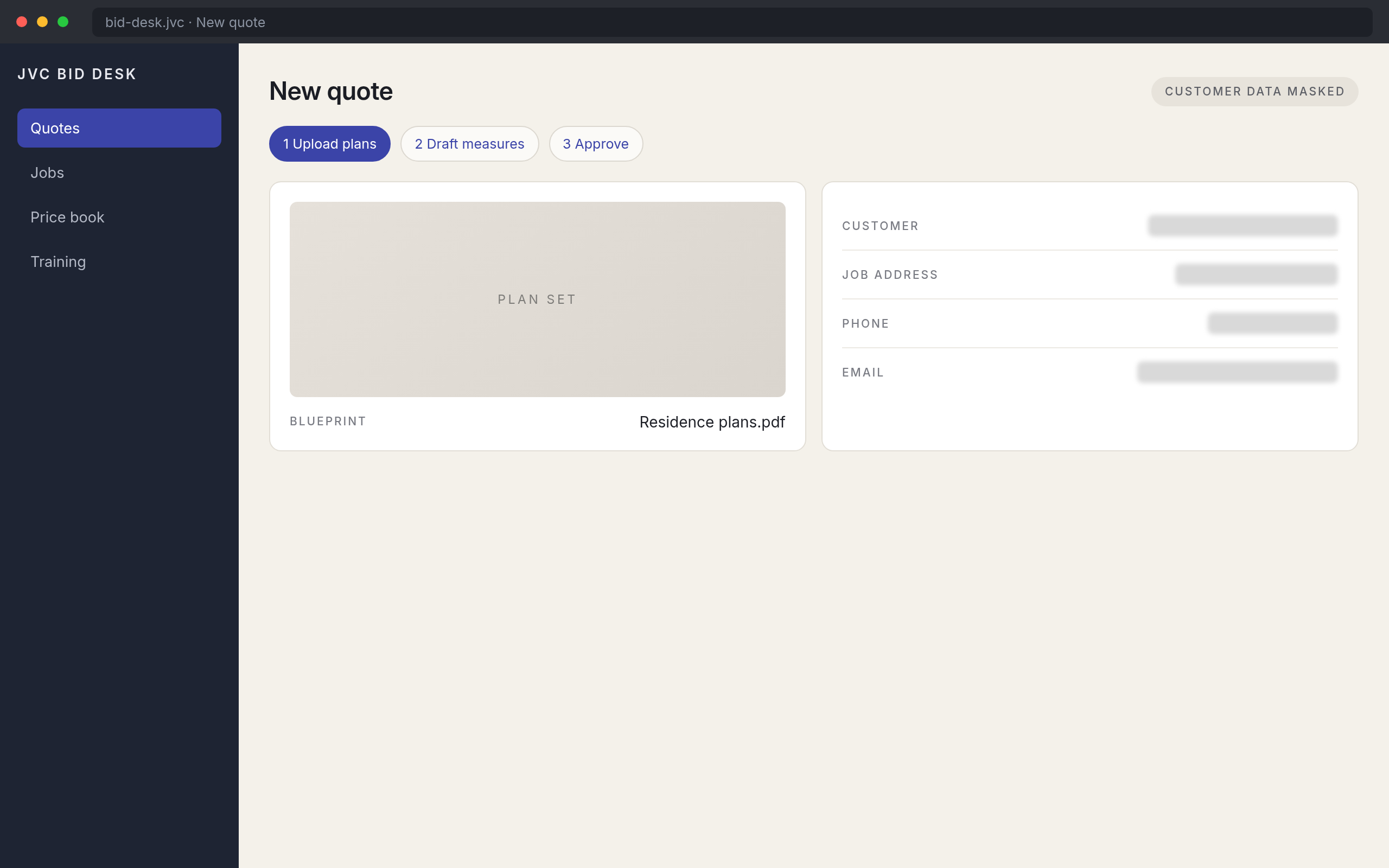
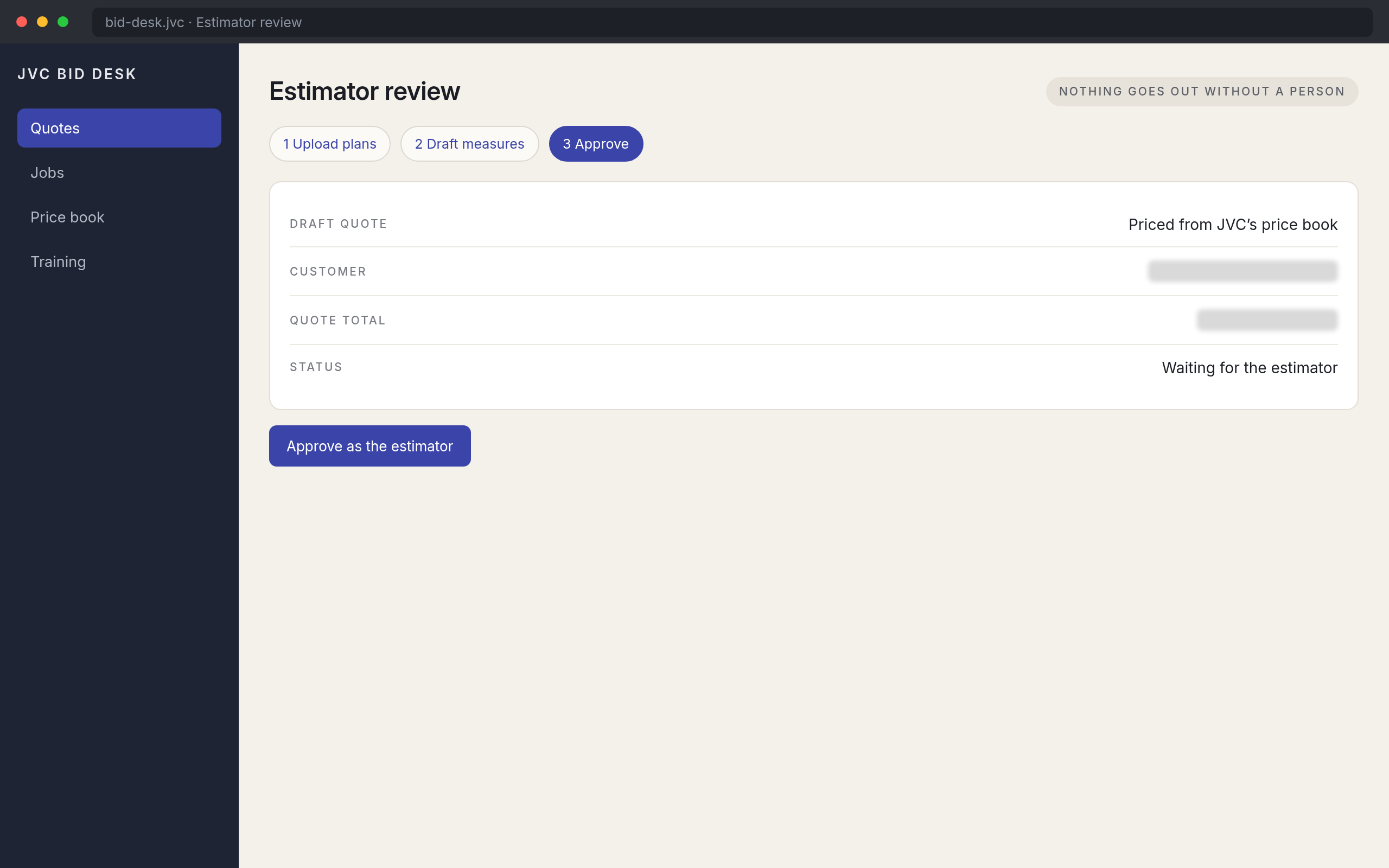
The result: the connected custom automated quoting system saved more than $10,000 per month. It’s built and now in testing, and a person signs off on every quote before it goes out. You can click through a demo on a sample job.
A distributor quoting from a price book or a takeoff can use the same pattern. Your pricing rules stay yours. The system drafts. Nothing goes out without sign-off.
Should AI write your quotes?
AI should draft them, and a person should sign off. AI is good at the first draft: reading a blueprint, matching products, filling a quote from your price book, spotting a number that looks off. It’s bad at deciding what your margin should be or which customer deserves an exception. That takes judgment.
The industry data points the same way. NAW’s 2026 AI Adoption Index shows AI’s first impact in distribution is capacity, like faster quotes and more orders handled, and 76.3% of respondents reported no workforce change (MDM). The workflows that work best keep a person in place to catch the exception. That’s not a limit. That’s the design.
Why is a quote more than a price?
Because a quote is where all four parts of the business meet.
- Sales owns the conversation and the follow-up.
- Marketing decides what the quote says about you: the proof, the options and why you’re worth it. That’s why Good-Better-Best options beat a single price and why documented proof sells before the number shows up.
- Operations owns the costs, the freight and what it really takes to deliver.
- Technology connects them so the quoted margin is the billed margin.
The glue is customer behavior. Which accounts ask for quotes and never buy? Which ones buy fast when the quote comes back the same day? Who always pushes for a discount, and who never does? Answer those and you’ll know where to put guardrails and where to give your reps room.
That’s not a quick fix. It’s a quoting system that protects margin every single day. And once the quote is right, the next leak is getting paid on time.
The 90-Min Diagnostic. In 90 minutes we trace a few of your real quotes from cost to invoice and map where margin slips out. Then we walk you through a few different ways to plug it, built around how your team already quotes, from a cleaner price book to a custom quoting system. You also see what the biggest distributors in your space are already doing about pricing and quotes. Within 72 hours you get a written list of the leaks and what to fix first. $2,500, credited toward the build if you go ahead.
Questions owners ask me
What is margin leakage in distribution quotes?
It’s the gap between the margin a distributor should earn and the margin it actually bills. It comes from handoffs around the quote: supplier cost changes not passed through, outdated price levels, discounts without guardrails, missed freight or small-order charges, and retyping errors between quote, order and invoice.
How fast should a distributor turn around a quote?
As fast as it can without losing accuracy. The first clear, credible quote often has the edge. Measure your current turnaround first, then cut retyping and approval waits with one price book and automatic routing for exceptions only.
Should AI write our quotes?
AI can draft quotes from your price book, match products and flag unusual numbers. A person should still sign off on every quote, because margin floors, exceptions and customer context need judgment.
How do I stop sales reps from over-discounting?
Give reps a margin floor and visibility into what each account is worth. Above the floor they decide. Below it, the quote routes to a person for approval. Review discount patterns monthly by rep and by account.
Sources: Distribution Strategy Group and Cavallo, "Closing the Execution Gap", source. MDM, "Vendor Costs are Eating Your Margin", source. Distribution Strategy Group, "The Hidden Cost of Inefficient Quoting in Distribution", source. MDM on NAW's 2026 AI Adoption Index, source. r/smallbusiness, "Quote generation process?", source.
Photo credits: Hero photo by Marmi Sica on Unsplash (Unsplash).