

Blog · Good-Better-Best
Growth is not more volume.It is learning to sell better without cutting the price.
Have you noticed good work going to a bid that was not better than yours, just clearer?
That is money and opportunity leaving the table. Not because your crew is weak. Because the customer only saw one price, so they shopped you on price.
I get it. You already run a real business. Mid-market manufacturers, distributors, and contractors in that roughly $500K to $20M band are busy delivering. Redesigning how you sell feels like a side project.
Here is the reframe I use with owners.
Growth for you is not “more volume at any cost.”
It is learning to sell better without drastically lowering prices.
You do that by adding or reducing value, not by cutting price. Good-Better-Best tiers are how the customer chooses the kind of value they want. They are not a discount ladder.
Price is one lever. It should rarely be the first one you pull.
What MACA fightsand what we propose
We fight quick wins, short-term strategies, and soulless communication that teaches buyers to compare you on the lowest number.
We propose a commercial system. Body, mind, and spirit have an analogue in business: Marketing, Sales, Operations, and Technology. A prettier PDF alone does not fix a leak. A tool alone does not either.
When someone says “AI solves everything,” we hold the line. AI is a useful tool if it has an owner and an outcome. It does not decide which upgrade your best accounts actually value, what each tier should cost against your margins, or which proof belongs on the story page. Those are judgment calls. That is the work.
Why a one-price proposal quietly costs you customers
An outdated proposal sends signals you never meant to send.
- A one-price PDF says“Take it or leave it.”
- A plain email quote says“We are small and busy.”
- No options says“Compare me on price.”
- Slow follow-up says“We are not that interested.”
None of that is true about your company. The customer only sees the page.
With a single price, they can only compare it to the other bid. The lower number wins. Buyers are also risk shopping. They want the choice least likely to go wrong. Showing quality matters as much as showing the number.
Good-Better-Best is about the kind of valuenot deeper discounts
A good-better-best proposal shows the same job as two or three clearly named options. Each one has its own scope and price.
Same crew. Same company.
Very different conversation.
Options give the customer control. They also give you a place to show what “better” actually means, so you stay in the running when your base price is not the lowest.
Research backs the psychology. People judge a price against the prices around it (anchoring). The set of options you show changes how each one looks. With three clear choices, many buyers lean toward the middle because it feels safe. Harvard Business Review has written for years on why a multitiered offer helps you attract price-sensitive buyers without starving high-end buyers of a reason to spend more. See Rafi Mohammed’s Good-Better-Best approach to pricing and his earlier note on why those prices work.
McKinsey makes the commercial point for B2B: shift from cost-plus toward value-based pricing, and use more margin levers than discounting alone (pricing in disinflationary times).
Clarity beats cleverness. The goal is to make the better choice easy to see, not to pressure anyone.
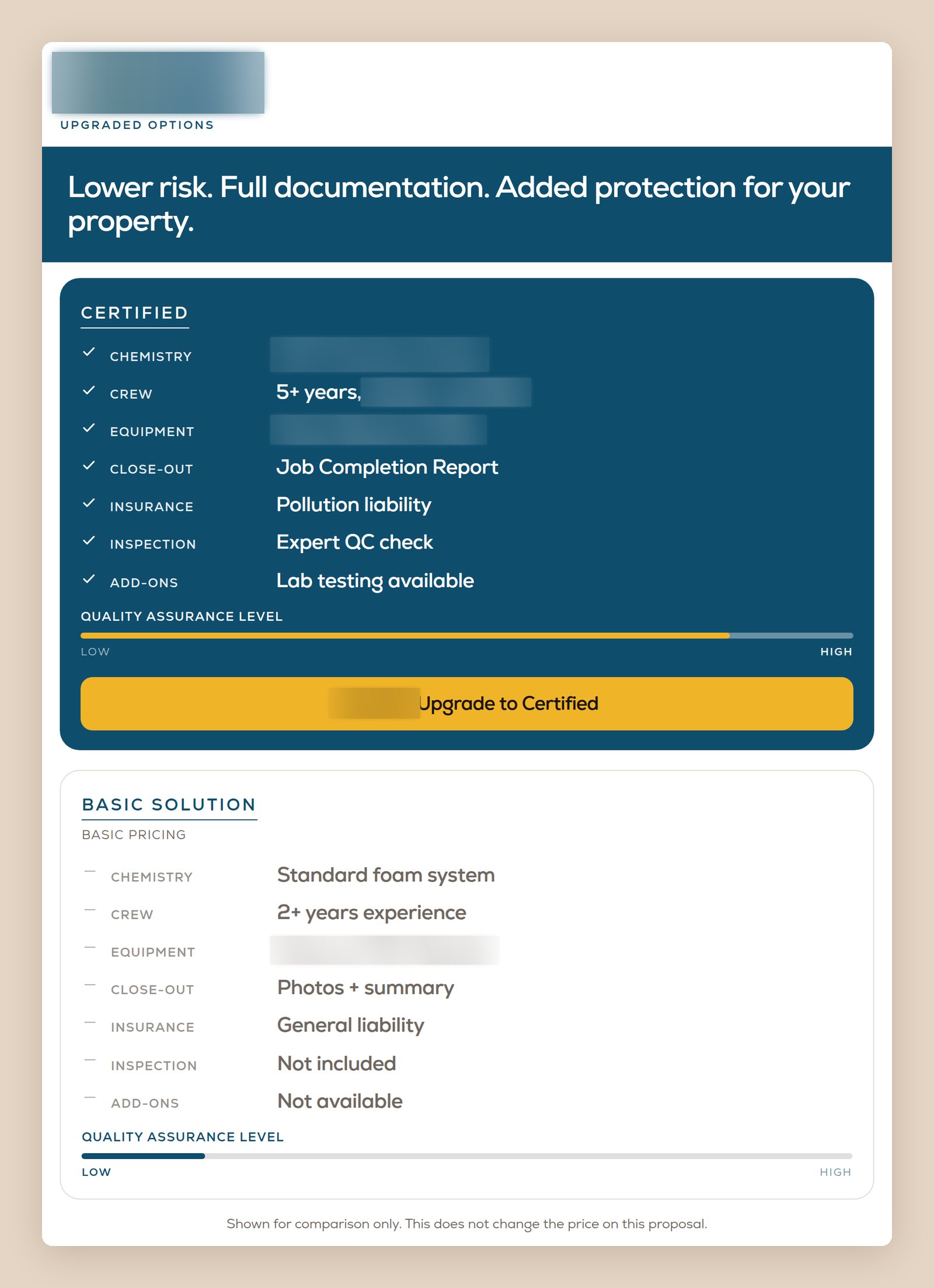
What this looked like for a mid-market spray-foam contractor
One client, a mid-market spray-foam contractor, was already in a strong place. Good reputation. Steady pipeline. Strong crews.
The issue was not the team. It was the proposal.
The upgrade lived in one buried line, so it read like an add-on. The quality work that set them apart barely appeared on the page.
We rebuilt the proposal around clear options. Four changes did most of the work.
We gave homeowners two clear options, Basic and Certified.
Instead of one price with a buried upsell, homeowners see two named options. Basic covers the job well. Certified is the upgraded option, built to a higher quality standard. Names match everywhere, from the website to the proposal. That is how trust builds quietly.
We showed one clear upgrade price.
Nobody does math homework. The Certified option shows exactly what it costs to step up, as one upgrade price on one button. One number is easy to weigh.
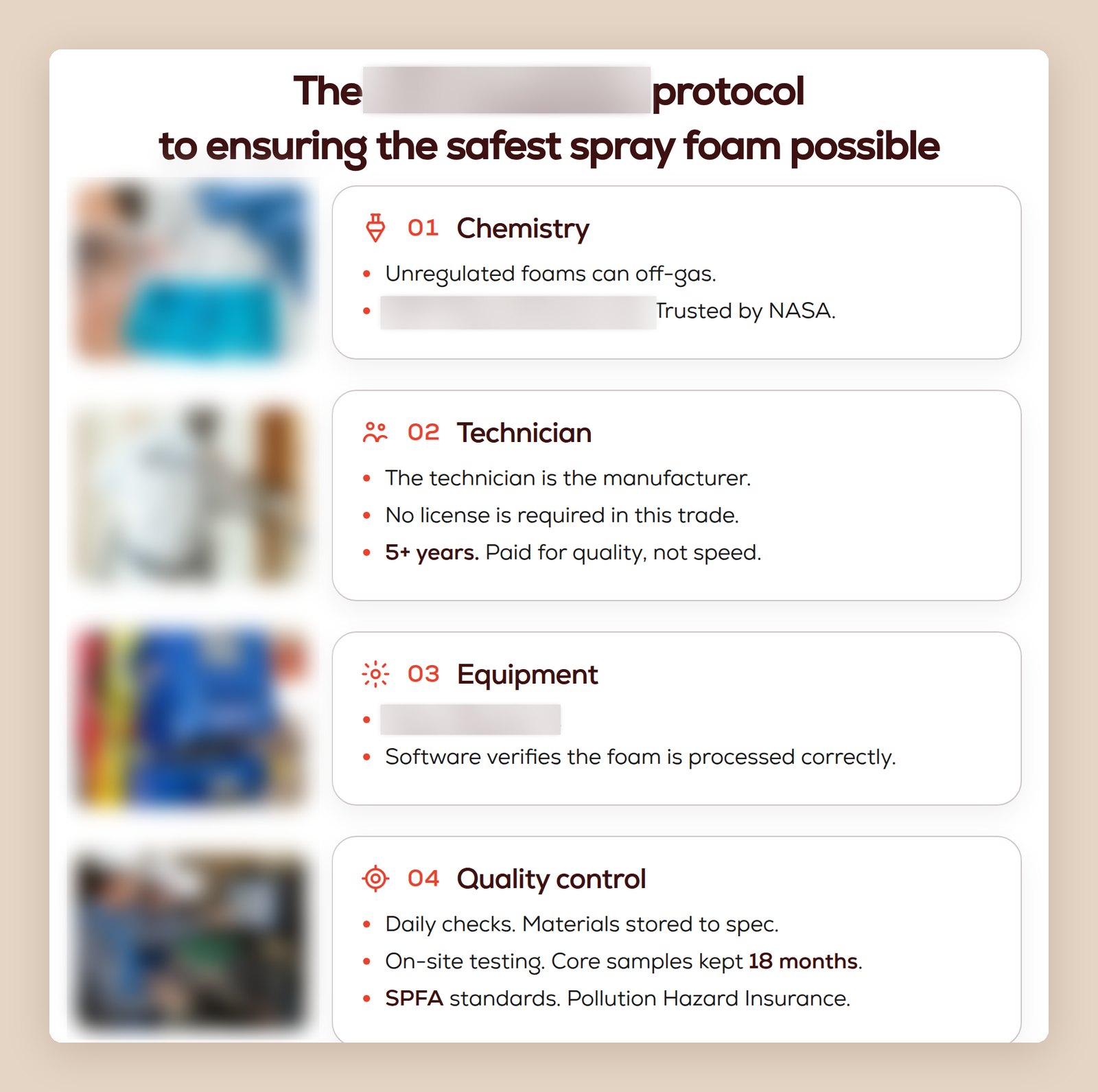
We added a page that tells the quality story.
This is where risk shopping gets its answer. A dedicated page explains what “Certified” means: chemistry, trained technician, equipment, and quality-control steps. Homeowners cannot see inside their walls once the job is done. This page shows what they are paying for.
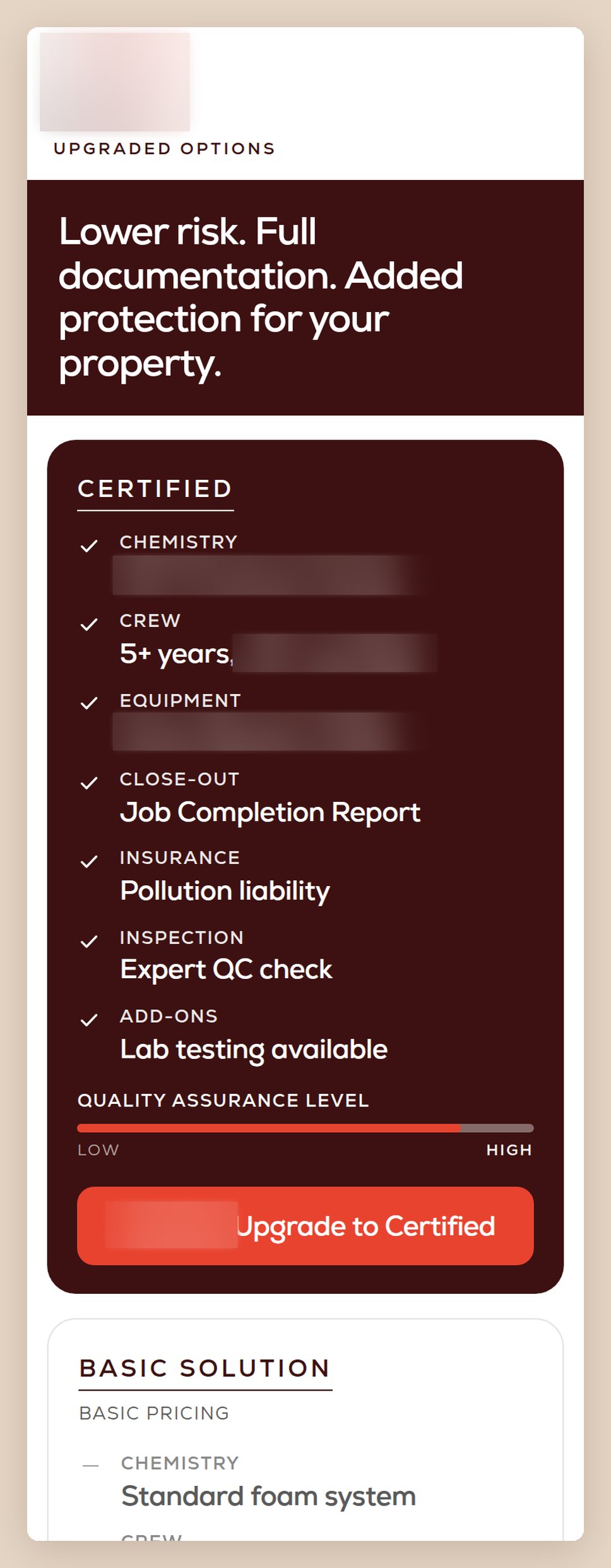
We stacked the options for the phone.
Many homeowners open proposals on their phone, where side-by-side tables fall apart. Options stack, one card above the other. They scroll, compare, and decide. Modern is not a flashy app. It is a proposal built for how buyers read today.
There was no discount and no hard sell. We did not lower a single price. We made the value visible.
See related case studies for how Marketing, Sales, Operations, and Technology connect on real projects. Interactive demos live there when you want to click through the pattern.
Build better tiers instead of bigger discounts
This is where many companies get tiers wrong.
They try to win lost customers with a discount ladder, where buying more means paying less. Every step up gives away more margin. That is not good-better-best. That is margin leaking out of every deal.
Done right, tiers give the customer the power to choose what kind of value they want. You get paid for the value you add instead of shaving your price.
This matters as much for distributors. A contractor account that only ever sees a price sheet has no reason to stay when someone else quotes lower.
Build tiers for those accounts around value, not price breaks. Start with two levers.
- Offer hours of service and training. Train the contractor’s crew on the product, and help them on their first jobs with it.
- Offer marketing support. Give them co-branded materials and product sheets they can hand to their own customers.
You can add other non-price levers that fit, like priority delivery or technical support.
Standard
They get your full line, fair pricing, and standard delivery.
Partner
Everything in Standard, plus:
- Hours of crew training every year
- Co-branded marketing materials
Premier
Everything in Partner, plus:
- More training hours, including on-site
- Hands-on marketing support for their local market
- Priority delivery
- A direct line to technical support
There is no extra discount in any tier. The contractor chooses the support that fits how they want to grow. You protect your margin. Your best accounts get more of you, which is why they stay.
Where tech fitsand where it does not
Modernizing does involve tools. You need a proposal that reads well on a phone, a template your team actually uses, and a reminder so every quote gets followed up on time.
You may already use ChatGPT to draft proposals. Fine. It can give you a good-better-best skeleton in seconds.
It still cannot decide:
- Which upgrade your best customers actually value
- What each tier should include and cost, given your margins and crews
- Which proof belongs on your story page
Those are commercial judgment calls. Tools amplify whatever strategy sits behind them. AI is a tool in that process. It never replaces the strategy.
Gut feel plus a generic template gets you a proposal with tiers. Strategy gets you tiers that sell.
How to modernize your proposal in 6 steps
- Start with your best job, not your cheapest. The option you would recommend to your own family is your upgrade tier. Then define a base option you are still proud to deliver. Build the step-up from added value, not a discount.
- Name each tier once and stick with it. Pick clear names (Basic and Certified, Standard and Premier) and use them everywhere.
- Show the step-up as one number. One upgrade price is easier to weigh than two totals the customer has to subtract.
- Tell the quality story on its own page. Cover materials, people, equipment, and checks. Specific beats generic.
- Design for the phone first. Stack the options vertically. Keep each card short: price, what is included, what is different.
- Follow up on time, and measure it. Decide who follows up on every proposal, and when. Track how many proposals go quiet each month, your upgrade rate, and your average job value, before and after.
If three tiers feels like too much, start with two. Our spray-foam client did.
The bigger point
Your proposal is often the last thing a customer reads before deciding.
If it looks outdated, you compete on price. If it looks professional and asks “which one,” you compete on value.
Your crew does excellent work. Your proposal should make sure they get chosen, and get paid for it.
The customers you are losing do not need more pressure. They need more clarity.
Questions owners ask me
How do I know if my proposal is costing me customers?
Look for the signs: one price with no options, a plain email or PDF that is hard to read on a phone, no clear explanation of your quality, and no set follow-up.
Then count how many proposals go quiet each month. If that number surprises you, the proposal is a good place to start.
What is a good-better-best proposal?
A proposal that offers the same job as two or three clearly named options at different prices, each with a defined scope. The customer chooses the option that fits instead of making a yes-or-no call on one price. The step up should add value, not a deeper discount.
Do I need three tiers?
No. Two well-defined options, a solid base and a clear upgrade, can work very well at the start. Add a third only if it is truly different and easy to understand.
How should I price the upgrade option?
Price it on the real value and cost of what you are adding, such as better materials, a certified process, or extra quality checks. Show the difference as a single upgrade price.
Should higher tiers mean bigger discounts?
No. Discount-only tiers give away margin and teach customers to push for the next price break.
Build higher tiers around value the customer can choose: hours of service or training, marketing support, priority delivery, or technical support. Distributors can use this with contractor accounts as well as homeowners.
Should a proposal use a side-by-side comparison table?
Tables work on a desktop but are hard to read on a phone. Many homeowners review proposals on mobile, so stacked option cards are often clearer.
Can ChatGPT write a good-better-best proposal for me?
It can draft the structure and the copy quickly. It cannot decide what goes in each tier, what to charge, or which proof sets your company apart.
Those take your business context. Make those decisions first, then use AI to help you write.
Sources: Rafi Mohammed, “The Good-Better-Best Approach to Pricing,” Harvard Business Review (Sept-Oct 2018). Rafi Mohammed, “Why Good-Better-Best Prices Are So Effective,” HBR (2013). McKinsey, “How to navigate pricing during disinflationary times” (value-based pricing guidance). INSEAD Knowledge, “Small Change, Big Rewards” (buyer psychology in tier order). Tversky & Kahneman (1974), “Judgment under Uncertainty: Heuristics and Biases,” Science. Huber, Payne & Puto (1982), “Adding Asymmetrically Dominated Alternatives,” Journal of Consumer Research. Simonson (1989), “Choice Based on Reasons: The Case of Attraction and Compromise Effects,” Journal of Consumer Research.